A leather carrying case for a portable tripod
Keeping a tripod handy while hiking.
I mentioned my Injecta Steinach model Ines tripod a while back, and that I intended to make a case for it.
It has taken the better part of two years, but I finally got around to doing it.
My wife and I visited some friends in what used to be East Germany. We thought we’d be doing some hiking and might need the tripod to take pictures of ourselves with our friends on the trail, so a couple of days before we set out, I pulled a scrap of leather out of my junk bag and put together a carrying case to hang on our backpack.
We did lots of walking, but no hiking. We were mostly in town, looking at medieval cities and famous places. We got a concentrated dose of German history and culture. I now have a fair idea why Goethe wrote Faust. This is not about that.
This is about a quick project that took about three hours on a Saturday afternoon.
I didn’t make any plans for this, and didn’t take pictures while I was working. I just sort of bashed it together in a hurry. Eyeball this, try that, try to sew it neatly.
| Carrying case |
|---|
 |
 |
 |
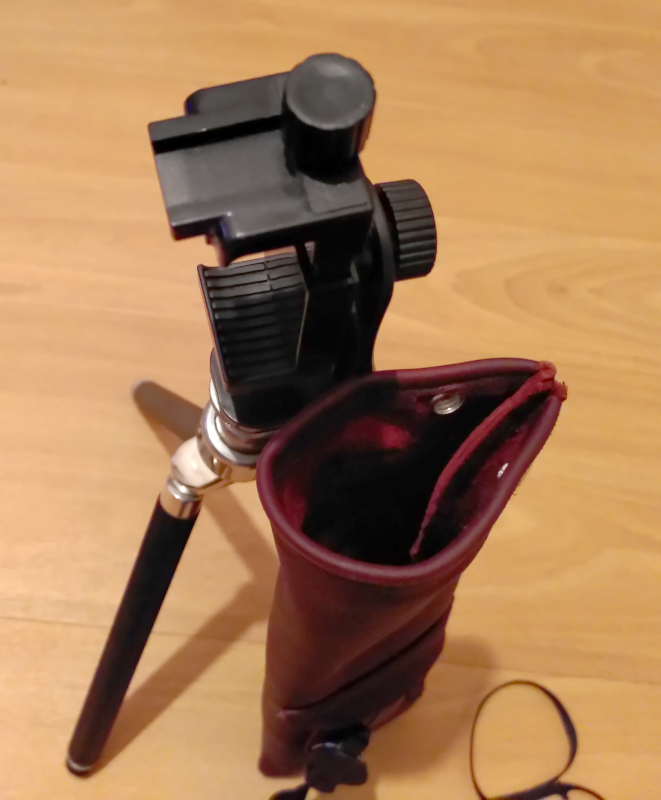 |
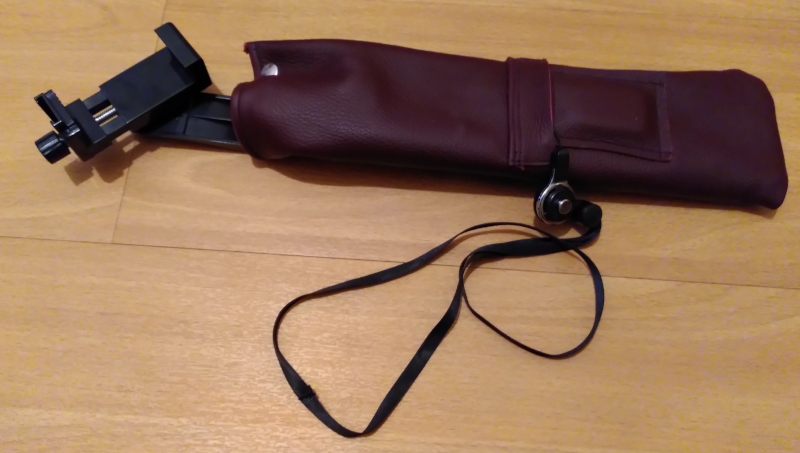
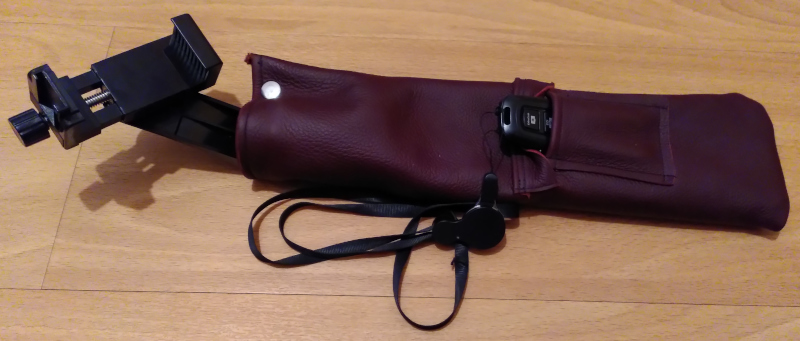
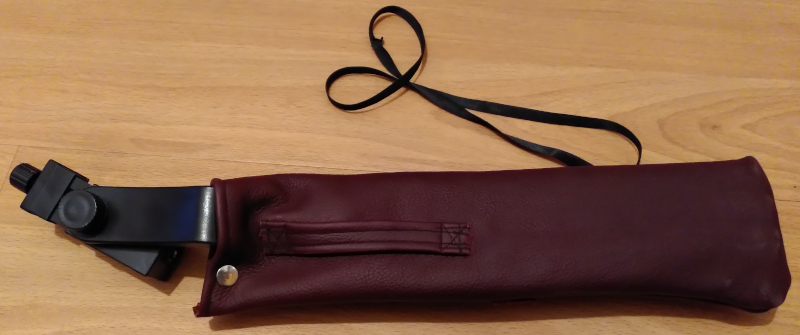
I put a pouch on the front to hold the Bluetooth camera remote control. There’s a beltloop on the back to slide over one of the wider straps on a backpack.
The pouch, its cover, and the beltloop were sewn on the flat leather for the case first. Then I sewed the seam around the top. I folded the case over with the rough side out, then sewed the edges together. The outer seam is double sewn - two seams parallel about 1/16 inch apart. The final step was to turn the case right side out.
The snap closes the mouth of the case over the shoulder of the tripod, keeping it from falling out.
The little pouch on the front doesn’t have a snap or velcro to keep it closed. There’s no room for a snap, and I don’t like velcro. The cap simply overlaps the pouch opening by about 1/4 inch. It’s easy enough to push it open and pull the remote out of the tight fitting pouch.
It looks nice (at least, to my eyes,) but it didn’t get a tryout on this trip. It made the whole journey in the trunk of the car, and never got used. Maybe next time.
We visited Eisenach, Weimar, and Meißen. If you know anything about German culture, then you’ll recognize all three.
| Wartburg over Eisenach |
|---|
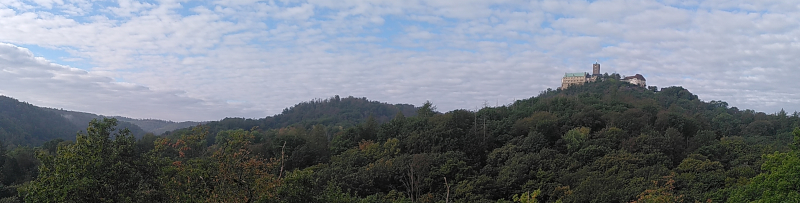 |
The Wartburg is where Martin Luther went into hiding after being excommunicated from the Catholic church. He wrote the first German translation of the New Testament while there, creating for the first time a common grammar and spelling for written German. The copies of the New Testament printed from his translation were the basis of modern German. Up to that time, there were Germanic languages but all of them had their own (local) spelling and grammar.
The view is from the balcony of the restaurant in the hotel where we stayed in Eisenach.
| Goethe’s “Garden house” in Weimar |
|---|
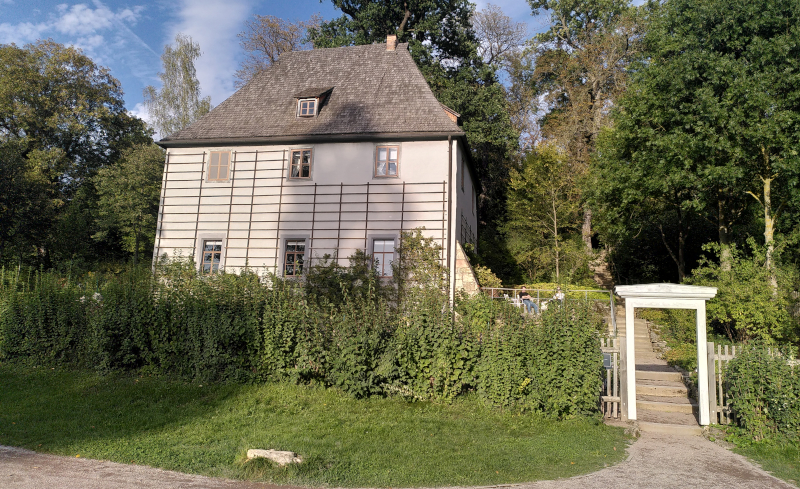 |
The city of Weimar (at the direction of Duke Carl August von Sachsen-Weimar-Eisenach) gifted Goethe two houses. First this house that is in what is now a park, and a second house (actually two houses joined into one) in town in the Frauenplan part of the pedestrian zone. I don’t think Goethe had to look very far to find his inspiration for Faust, the man or Faust, the book. His deal with the Duke provided him with pretty much every material thing he could have wanted, and darned near all the intellectual challenges he could have dreamed of - with no way out once he had accepted.
| Albrechtsburg castle in Meißen over the Elbe river |
|---|
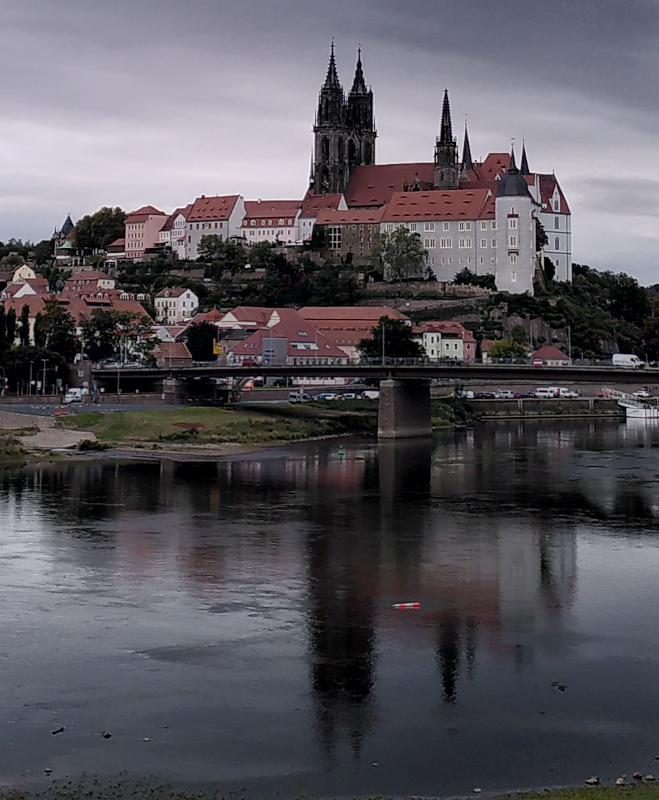 |
The Albrechtsburg sits on the spot where Meißen was founded 1000 years ago. It was here that German craftsmen duplicated the white porcelain made in China, becoming the first European porcelain manufacturers in 1710. The Meißen porcelain factory was actually in the castle for many years, until a fire in the factory nearly set the castle and the church on fire.
Meißen porcelain is famous, good quality, and expensive. They have all of the forms and things that it takes to recreate any of the items they have produced since 1710. If you find an antique piece of Meißen porcelain, they can make you a new one - if you can pay the piper.
You’ve got to wonder who ordered this thing, and why:
| Tacky porcelain vase |
|---|
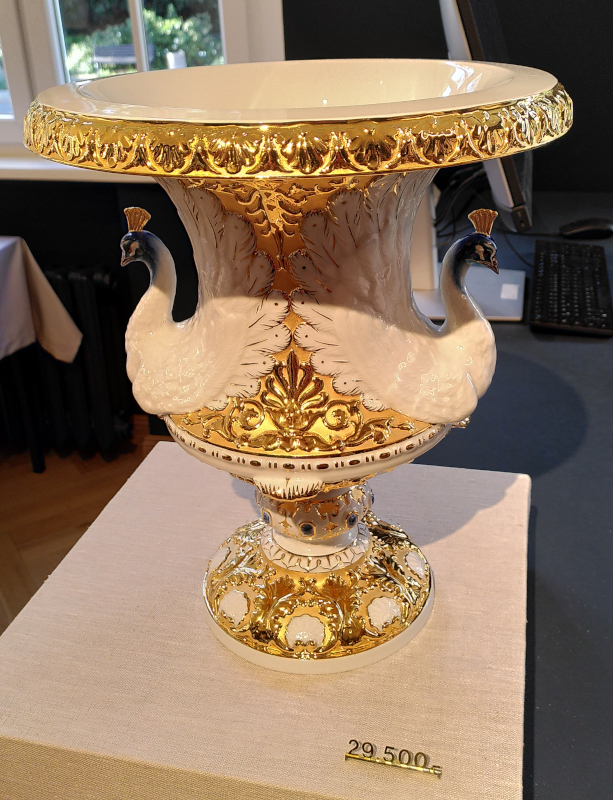 |
Note the price.
Our final stop won’t mean much to most of the world. We went to see the Moritzburg castle about 10 miles from Meißen.
For anyone outside of Germany, it is just a random castle parked in the middle of an artificial lake in what was the king’s hunting grounds, notable only for the many deer heads decorating its walls.
For anyone in Germany, it is the Cinderella castle. There is a Cinderella movie, made in 1970 in cooperation between a Czechoslavakian film studio and a film studio in East Germany. It was made with Czechoslavakian and East German actors and actresses. While most of the movie was made in Czechoslavakia, the scenes of Cinderella at the ball and of Cinderella losing her shoe were filmed at the Moritzburg in Germany. This film runs on German TV every year around Christmas. It is known to East Germans and West Germans alike. It is traditional to watch at least one showing of it around Christmas with your kids (at least, in our household it was.)
The movie is available on DVD, but only in German and Czechoslavakian. To the best of my knowledge, it has never been translated to any other language. (There is an over-dubbed English version, but it is some English speaking grandpa telling the story over the original sound track in German or Czechoslavakian. There is no properly dubbed version in any other language.)
| Moritzburg castle |
|---|
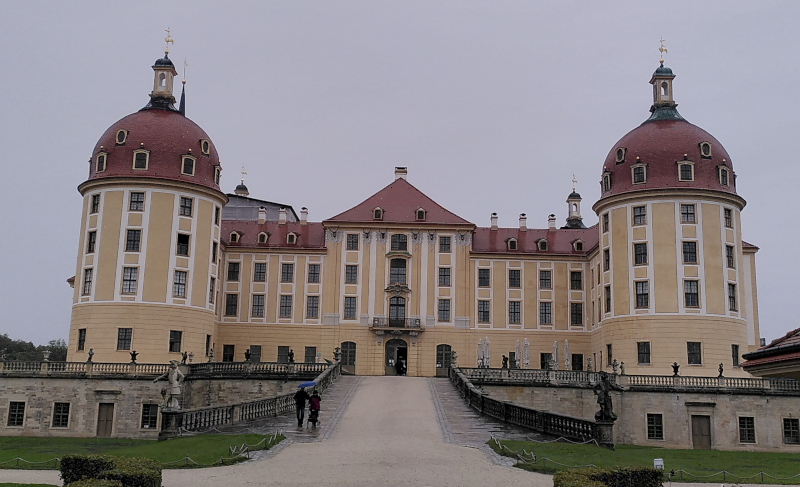 |
The Moritzburg also has a connection to where I live, though we didn’t know it until we were actually inside the castle taking the tour. Stanisław Leszczyński served Augustus II the Strong in the Moritzburg. Stanisław Leszczyński was later elected king of Poland, then deposed. He went into exile, spending part of the time in the town I currently live in. There is a historical marker here on a building that was a hotel where Stanisław Leszczyński lived when he was here.