Investigating brass pins and wooden scales for knives
Which breaks first, the wood or the brass?
When I made the apple wood paring knife, I found on various forums that you shouldn’t simply pin the scales to the knife. Everyone says you’ll either split the wood or the scales will fall off. You should always use epoxy. Right.
Since I didn’t split the scales and they stayed on tight, I got to wondering just how well it actually works and how it all holds together.
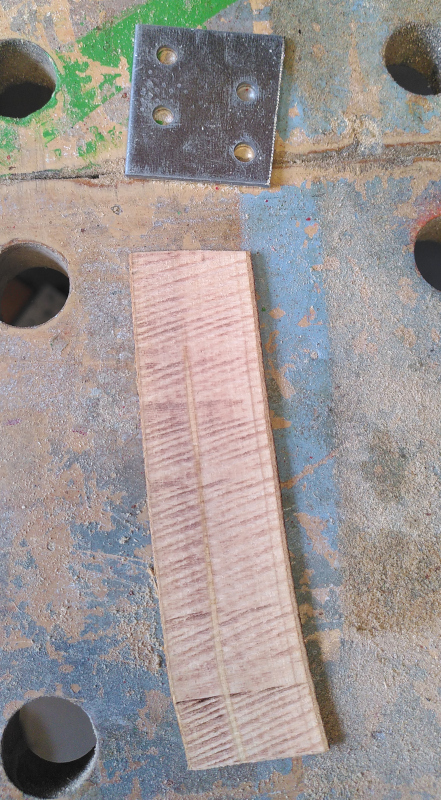
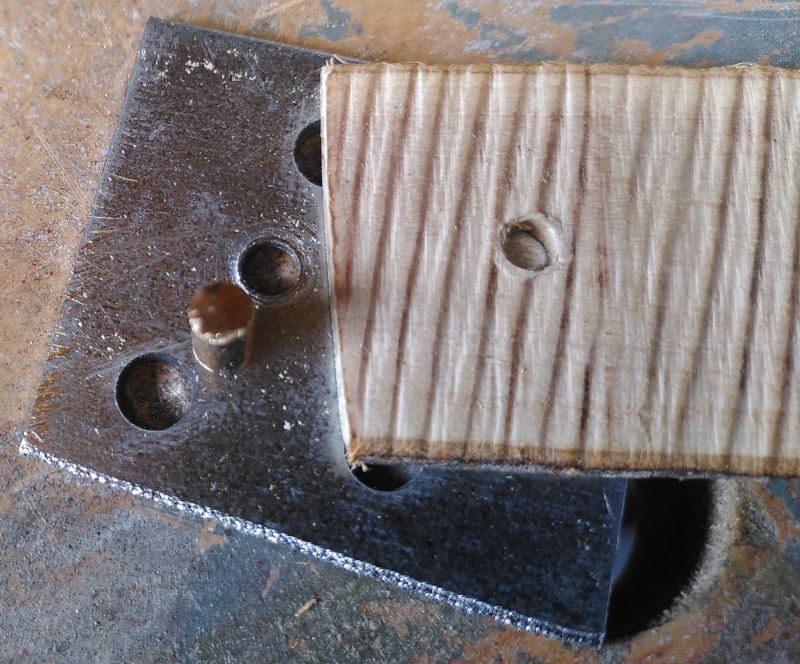
Rather than risk messing up my second Cocinero 90 blade, I used a scrap of flat steel along with some scraps of apple wood and beech wood to do some experiments with brass pins.
| Materials |
|---|
 |
 |
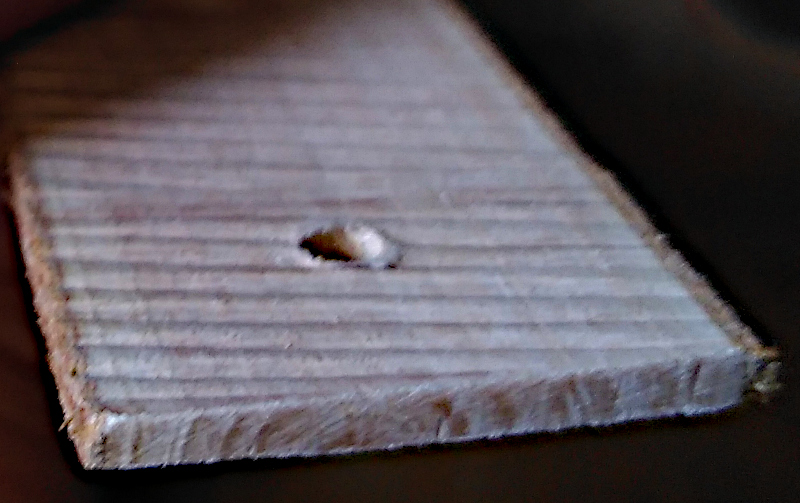 |
The wood is actually maximally bad for this.
- The rings in the wood are perpendicular to the steel.
- The wood is only a couple of millimeters thick.
Wood likes to split between the rings, so spreading a pin stuck through that way ought to really split it right along the grain. Being just a couple of millimeters thick, it doesn’t have much “meat” to absorb the spreading from the hammered brass.
Given all the warnings I found out on the internet, and my own expectations, I figured it would split right away. Like, on the first hammer blow.
That didn’t happen.
I whacked it once with the center punch, lightly. Dimpled the brass, and the wood stayed stuck to it.
Whacked it again, lightly. Deepened the dimple, the wood said “So what?”
Whacked it again, not as lightly. Still no reaction from the wood.
OK, time to get rowdy.
I whacked it several times, increasingly harder. The final blow was about like what I’d use to drive in a finishing nail.
Guess what happened.
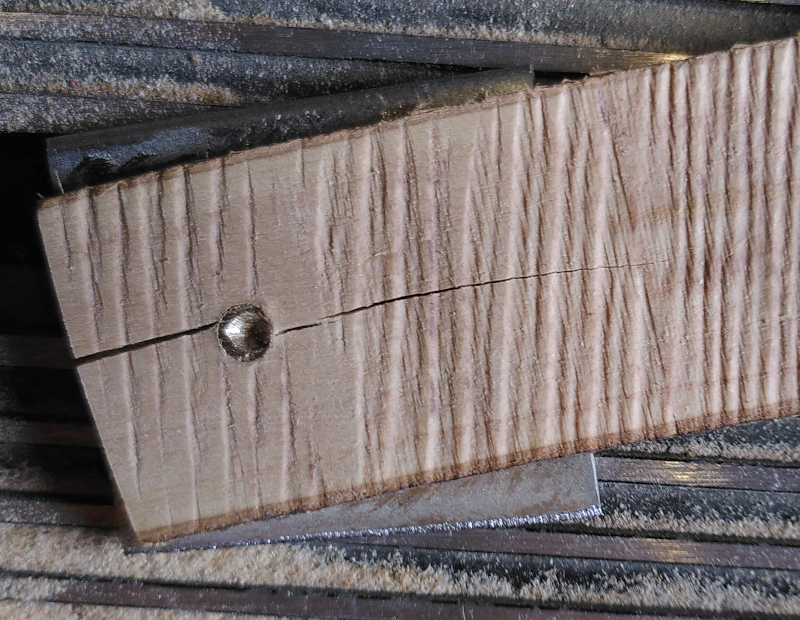
The brass shattered, allowing the punch through to break the wood.
| Broken brass |
|---|
 |
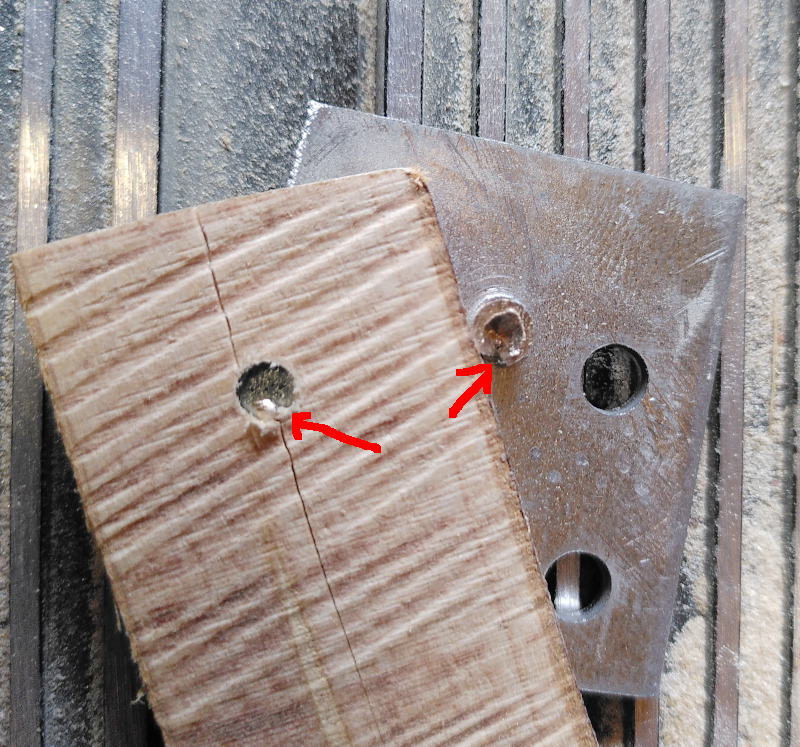 |
As expected, the wood split along the grain.
Unexpectedly, it was the brass that broke first.
You can see the broken out spot in the pin and the small chunk of brass stuck in the wood in that last photo. The brass shattered, and the center punch drove the brass crumb into the wood grain at a funk angle. That split it along the grain, with the spread wood also splitting on the far side of the hole.
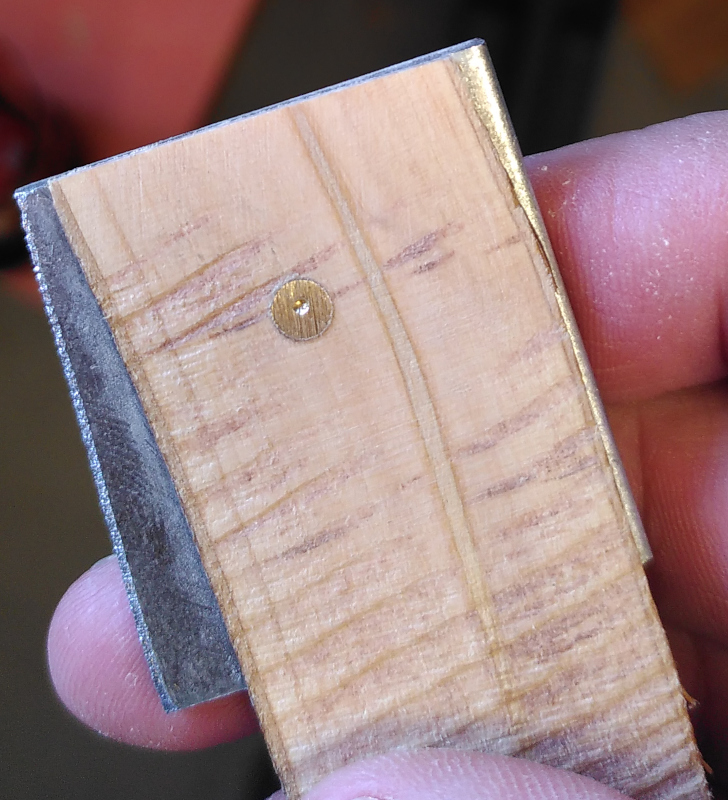
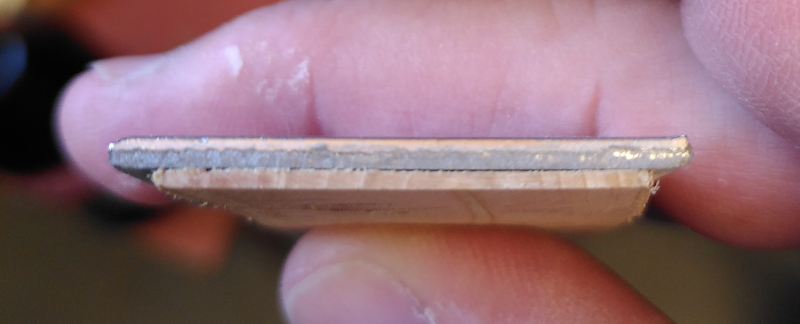
I wanted to see what the peened brass looked like inside the wood, so I drilled a hole in the other end of the apple wood scrap and pinned it to the steel plate. I intended to cut the wood and steel then grind the end to show a cross section of the wood, the brass, and the steel.
| Wood, brass, steel |
|---|
 |
 |
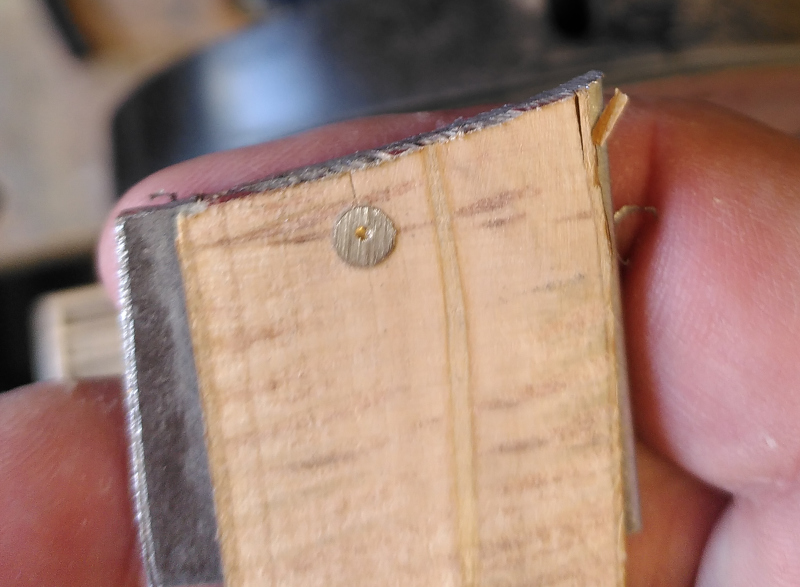 |
The brass pin holds the wood tight to the steel, despite a very moderate (one light blow) dimple. I used a hacksaw to cut through the steel and the wood so that I wouldn’t have to grind my way through a centimeter of stuff. That was a bad idea - that actually managed to split the wood.
Keep in mind, that’s with me working a hacksaw through a thin piece of wood and some steel. Notice that the wood didn’t come unpinned. It stayed stuck despite being handled with brute force.
I really don’t think the pinned scales on my apple wood knife are going to fall off. They are well dimpled and solid.
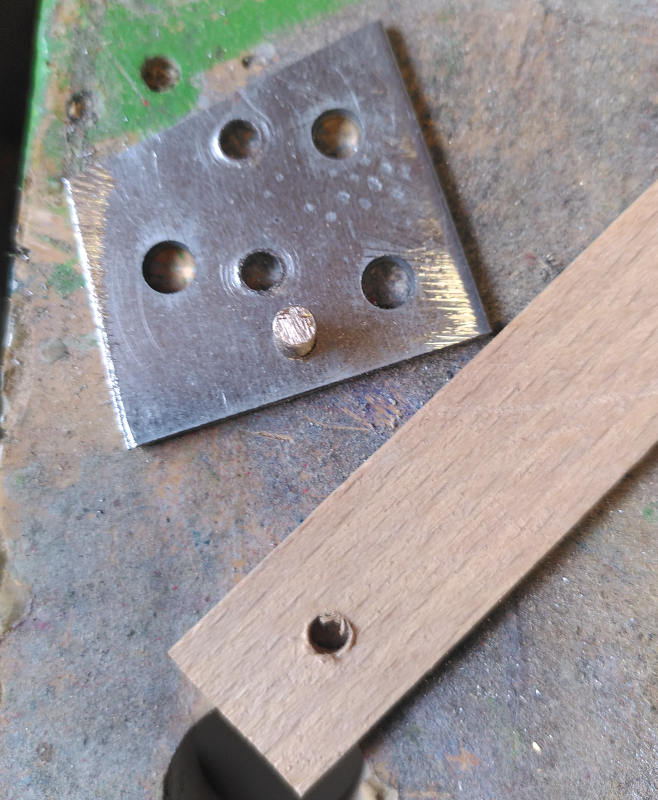
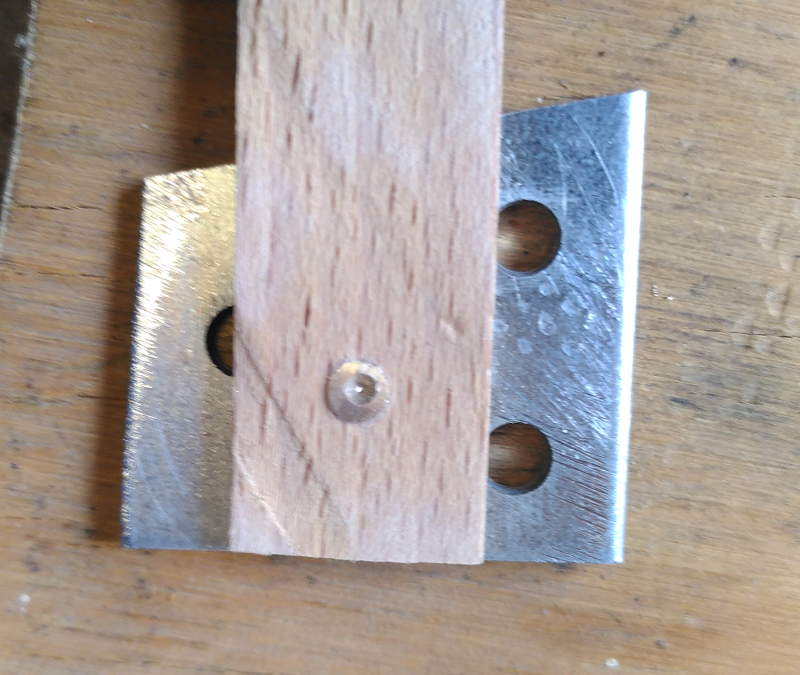
That was all with apple wood, which is a very hard wood indeed. For a comparison, I rooted out a scrap of beech wood about as thick as the apple wood was, and tried again.
| Beech and brass |
|---|
 |
 |
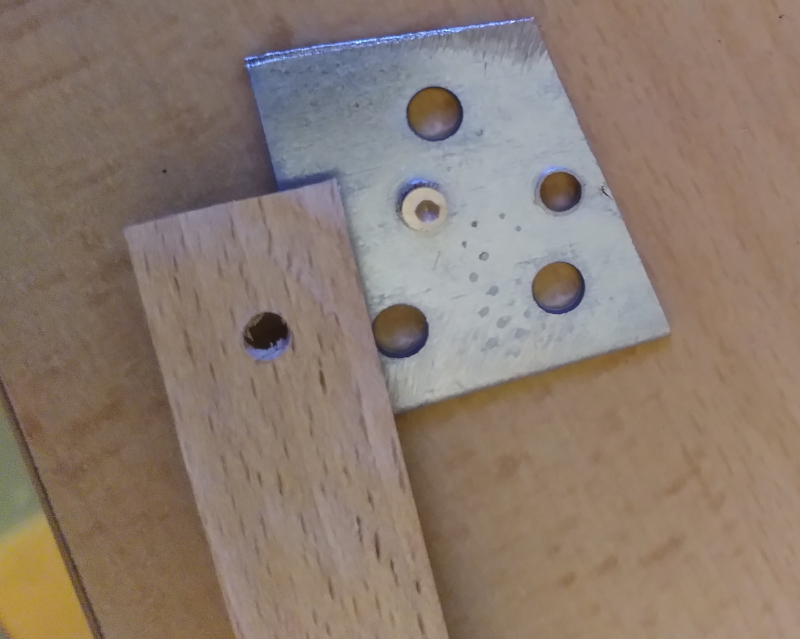 |
I didn’t test this one to destruction. Instead, I put a moderate dimple in the brass, then used the length of the wood scrap as a lever to see what it took to pop the wood off of the pin.
Judging by how hard I had to lever that wood to get it off the pin, you’d have to take a chisel to the scales on a knife to pop them off of the knife. You’re not going to knock them off in normal (or abnormal) use. You could probably work them loose if you use a hammer to drive the knife through frozen food, but if you do that you deserve for your knife to fall apart - and epoxy won’t save you there, either.
For curiosity’s sake, I measured just how far the pins spread on the various experiments.
| Experiment | Result | Photo |
|---|---|---|
| Test to destruction in apple wood | Pin spread to 4.73mm | |
| Mild dimple in apple wood | Pin spread to 4.12mm | 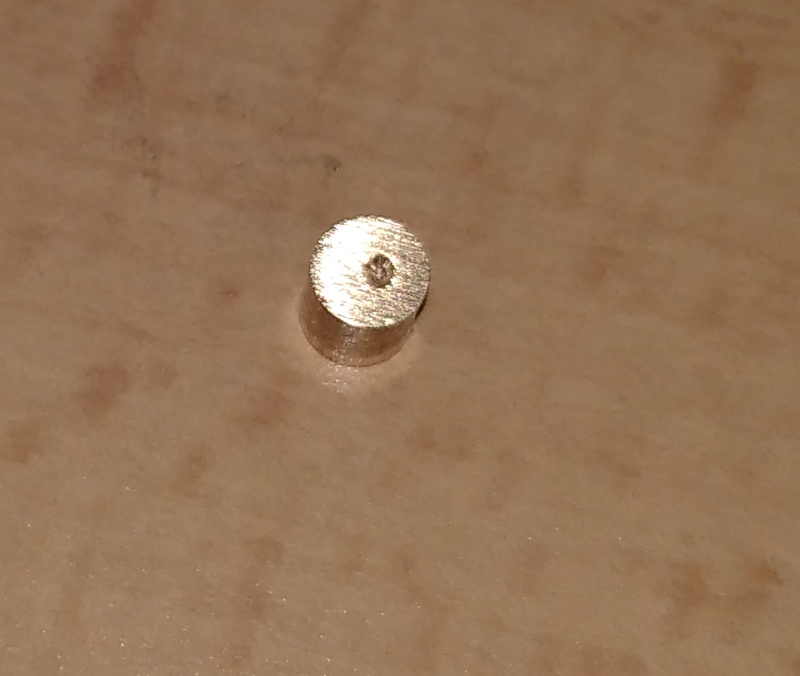 |
| Moderate dimple in beech wood | Pin spread to 4.25mm | |
| Test to destruction, bare pin | Pin spread to 4.8mm | 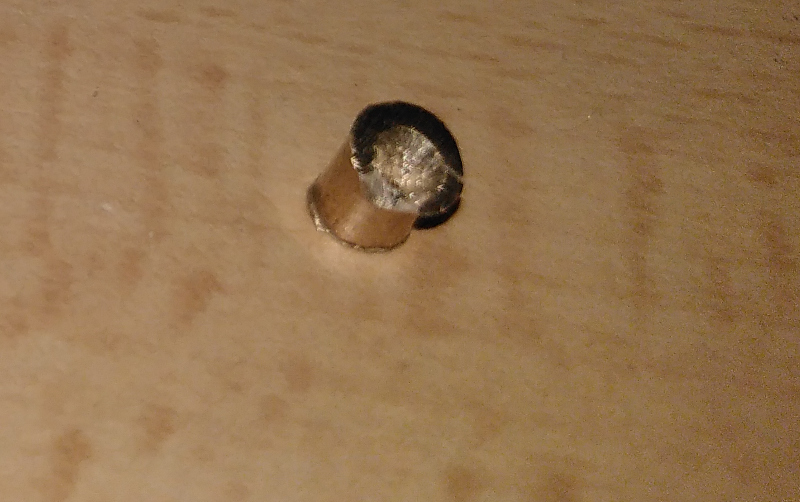 |
It looks to me like it should be no problem to use a moderate dimple in the pins. It holds just fine, and doesn’t split even beech wood when used along the grain.
The brass pins only spread in the upper 1 mm or so. If you are really worried about splitting your scales, you could give them a slight countersink. No more than about 0.1mm chamfer, and no more than 1mm deep - then use light taps to make a moderate dimple in the pin.
On thicker wood, and if you put the wood rings parallel to the blade (like I usually do,) then I really don’t see a problem with the scales staying on the blade.
Next time around, I might try grinding the pins down close to the wood, hammering them flat for a “mushroom” effect, then grinding them even with the wood - and maybe using a slight countersink on the holes.
A layer of epoxy between the scales and the wood will, of course, keep water from getting in.
I wouldn’t try this with burl woods and the crumbly crap that has to be “stabilized” for use in a knife handle. It looks nice, but it probably won’t like the pinning. Keep using epoxy and decorative pins on that kind of stuff. Pins only is only for good, solid hardwoods.